Which materials are used to paint on is just as important as what is depicted in a painting.
Materials all work in their own unique ways, some soak in moisture more than others, some are rough and some smooth. Lately I have become interested in ways materials that host the depictions become integral to the work, In vs Onis a piece of writing which explores an understanding of materials through research, what is essentially a support becomes as important as what the imagery is. Visual representations helped through the materiality which it sits on, but also the materials framing becoming even more relevant than a depiction, this material of frame becomes more relevant in abstract art such as Kim Pieters and Glen Snow, two artists whose work showed at two rooms gallery, which I was lucky enough to see, called ‘Materialised’ [1].
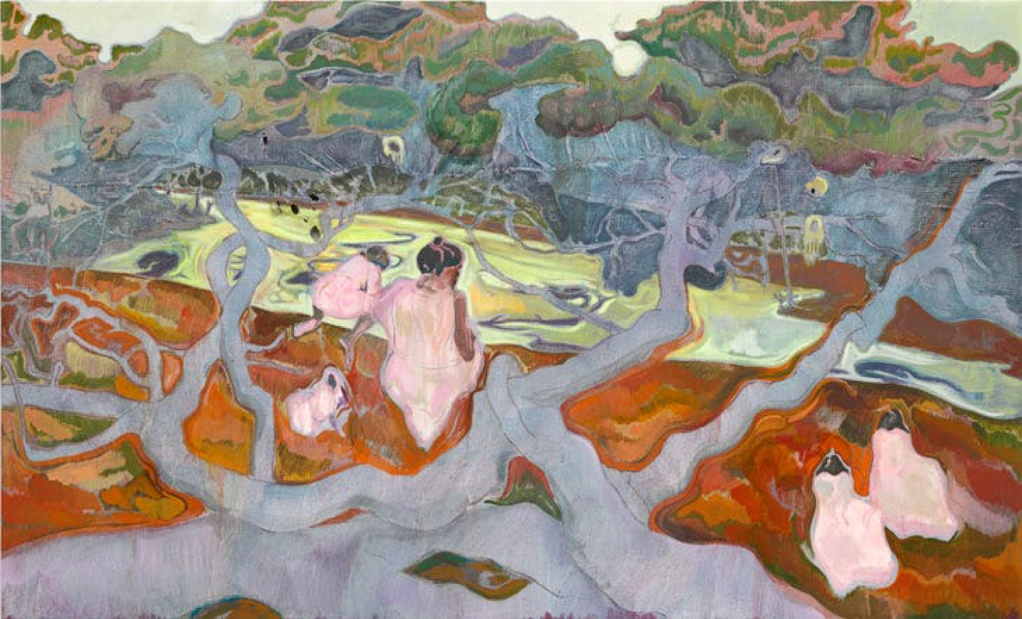
Michael Armitage is a Kenyan artist who paints on Lubugo bark cloth, this cloth is made from bark off of a specific African tree, the process of gathering the bark is to Armitage a strong connection to his personal background. The images depicted in , Baikoko at the mouth of the Mwachema River (2016) show two girls by a river bed, the river snakes through the middle section of the canvas. The painting shows these girls surrouned in a natural setting, almost a reference to the collection of the bark and the relationship people have towards these places, the bark shows through some places although washed over.
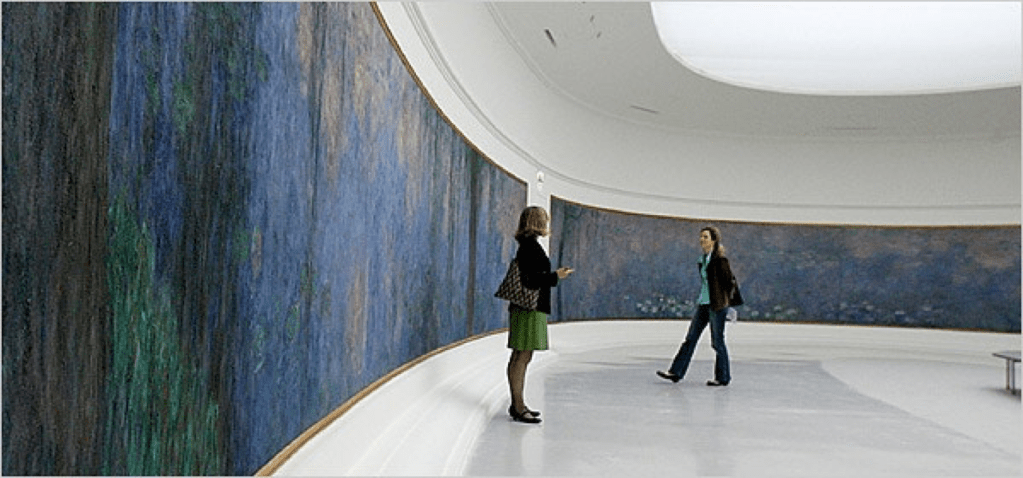
I have recently come across the idea of multiple panels placed next to each other, although this is mainly seen as in canvas there is something that resonates with building and reshaped size boards manufactured to the same size, these multiple panels both, to me, give a sense of building structures from putting up wall panels for new houses or even renovations, they reference the manufactured and multiplication of a single size, something that may not have been as easy of effective in the past.
Discussing the past and multiple panels though we may view diptychs and triptychs as being of multiple panels though, but mainly as alter pieces or pieces of furniture which close up on them self. But further down the line the use of multiple boards comes more present with accessibility to the outdoors, shown the multiple boards in works such as Monet’s Nymphéas(1922) consisting of multiple boards placed next to each other. Cars are a restriction on what size boards are easier to move around, again, restricting what size boards are being used as not to rely on shipping as that begins to cost a lot of money, but also using found materials it’s a matter of what can be taken to and from certain places.
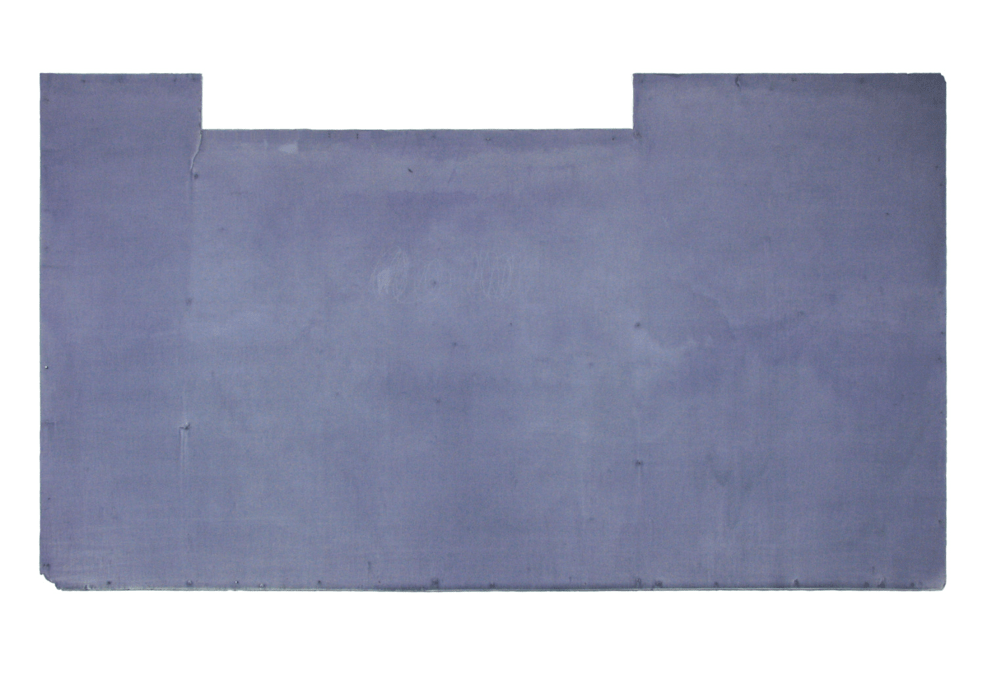
Within my own practice I am beginning to look at the relationship that MDF boards have with building infrastructure and the history of painting to contemporary uses of panels or paneling. In Pieters work‘All Thought emits a Throw fo the Dice’ (2013) shows washes of purple grey with ‘primitive scribbling’ over top [2]. These washes bring our attention to the materials physical properties, giving it weight and a sense of time in relation to processes, this being reflected in the ways in which Pieters works on these MDF panels.
Left behind marks of found objects are an attribute of the materials used which I am, myself, enjoying with Pieters work and within my current practice, I get pulled in as if they were brush details like looking at the back at some historic paintings, pulling stories which only become apparent the more it becomes looked at observes, a nail re nailed showing the building process and accidents, tares opening up ideas of dismantling these materials or breaking down deconstructing a house or room, these attributes add so much to the reading and is often highlighted through the washes of paint which seep into the marks making them often darker as the accumulate within the scratches and tears, darkened amongst the pale purple grey panel.
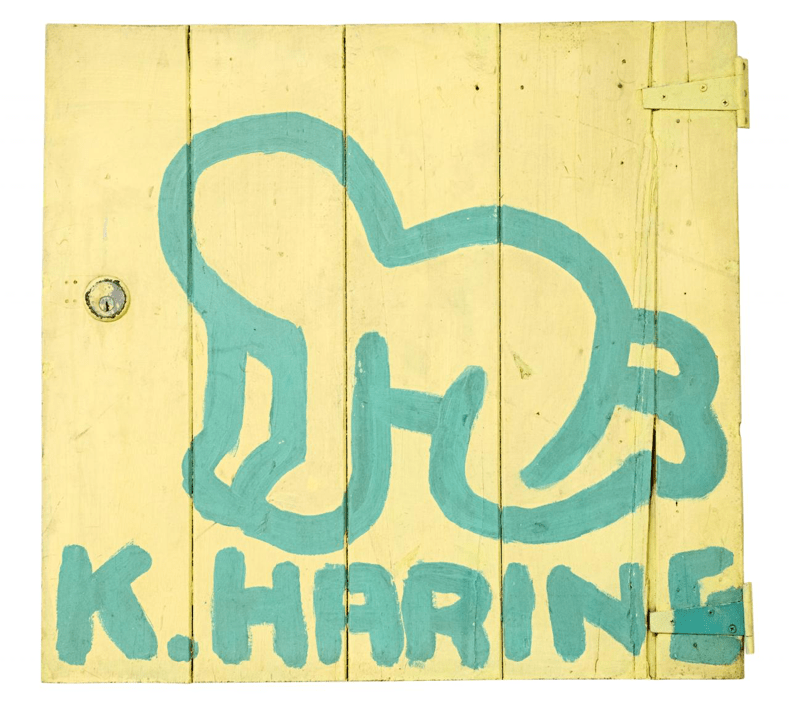
Keith Harrings painting shows another case of using a found or discarded panel which may resemble something from a building, on this instant we see a figure on its hands and knees with a signature written in capitals underneath, almost as Harring is claiming this door as his own or worshipping it. The parts which I am drawn into are the lock, not fully painted over, it is the only part shown which isn’t covered fully with the yellow paint, exposing some of the doors history to the viewer, the grey / silver shines through. Another part which attracts my attention are the hinges, hinges which not only sit on a door but also on a wall. Five boards going vertically break up the image on top, nothing is fully hidden to the viewer, although there is a layer of yellow, the door itself reveals its self, still breaking up showing its errors and flaws, grains and splits.
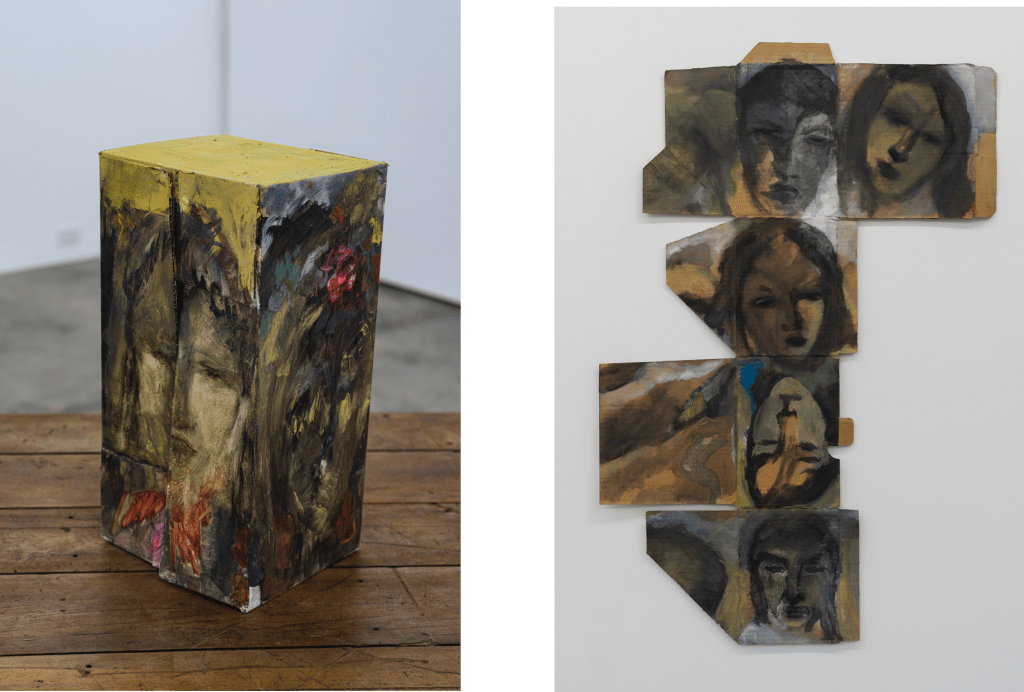
Figure 6 (Right). Star Gossage, Untitled, 2020
Star Gossage is an artist from Aotearoa who mixes clays, wood resins and other naturally sourced pigments mixed with oil paints to dull paintings to give them an earthy tone, normally depicted are “often feature dream-like tupuna figures who seem imbued.” [3]
In the untitled works above are two word made from cardboard boxes with what seems to be the faces of said tupuna, this industrial material holds an earthy tone of itself but also is a canvas which showcases the depicted images, in the right ‘Untitled’(2020) work the material is almost evident by its shape and lay out, the unfolded version on a cardboard package is very immediately recognizable, and to it opens questions to why this specific material in relation to what is depicted, but mostly the past life of the object and packaging, what was this used to house? Who bought the item and is the item important in relation to the painting?
The use of material seems to be a big part of all of these paintings often elevating the meaning of what is painting on top or helping in expanding the meanings which we give to these items themselves. In my own studio I am begging to look at how materials can help connect the message I am trying to convey whilst holding up the images which I am depicting on to the. I have regularly used wood boards as my ‘canvas’ but have recently been trying to explore materials found in both housing construction and conservation, these materials are almost an aid in a conflict in how the landscape is being looked at and used, on one side trying to maintain and steward and the other to destroy or add new meanings to the land.
Bibliography
References
- Two Rooms. “Materialised”. https://tworooms.co.nz/exhibitions/materialised/(accessed April 28, 2020)
- Snow, Glen. “‘All Thought emits a Throw fo the Dice’, 2013”. Auckland: Two rooms Art Gallery, 2017. Published following the exhibition Materialised, at Two rooms Art Gallery, Auckland.
- TimMelville. “STAR GOSSAGE”. https://www.timmelville.com/artist/star-gossage/(accessed June 16, 2020)
Illustrations
Figures
- Armitage, Michael. Baikoko at the mouth of the Mwachema River.2016. Oil on Lubugo bark cloth. 330 cm x 220 cm. Turner Contemporary, Margate: England, https://www.apollo-magazine.com/i-always-feel-like-im-looking-in-michael-armitage/
- Monet, Claude. Nymphéas.1922. Oil paint on boards. 9100 cm x 200 cm. Musée de l’Orangerie, France, https://static01.nyt.com/images/2006/05/16/arts/orang.span.jpg?quality=90&auto=webp
- Pieters,Kim. ‘All Thought emits a Throw fo the Dice’. 2013. Mixed media on board. 1750 mm x 1000 mm. Two Rooms Gallery, Auckland: New Zealand, http://kimpietersstudio.com/the-mallarme-suite/
- Haring, Keith. Untitled (Mural signature door). 1984. Synthetic polymer paint on wood and metal. 65.2 × 71.7 cm irreg. (variable). National Gallery of Victoria, Melbourne: Australia. https://www.ngv.vic.gov.au/explore/collection/work/114209/
- Gossage, Star. Untitled. 2020. Earth pigments and acrylic on found cardboard. 405 mm x 210 mm x 180 mm. Tim Melville, Auckland: New Zealand. https://www.timmelville.com/artist/star-gossage/
- Gossage, Star. Untitled. 2020. Earth pigments and acrylic on found cardboard. 875 mm x 580 mm. Tim Melville, Auckland: New Zealand. https://www.timmelville.com/artist/star-gossage/
 Llenyd Price
