I have had a fascination with the connections scientific processes have with making work and how the ideas within that fascination can help drive my practice. Being interested in a scientific method, ways of starting a project or work slightly changes, the way I approach making and looking changes, I normally form drawings or sketches of ideas out onto paper much like a hypothesis, and then materials, marks and other forms of making overlap almost as tests of the experiment. I have also tried to find the wonder of scientific apparatus, incorporating these devices into my work to help add to a narrative of possible solutions or ways in which I may deal with the issues I explore and try to understand.

Johann Böhm was a German Bohemian chemist, his work looked at magnetic fields. To me his cyanotype prints have an almost abstraction, the magnetic waves are fairly expressive and resembles paint, this to me is elevated through the print methodologies.
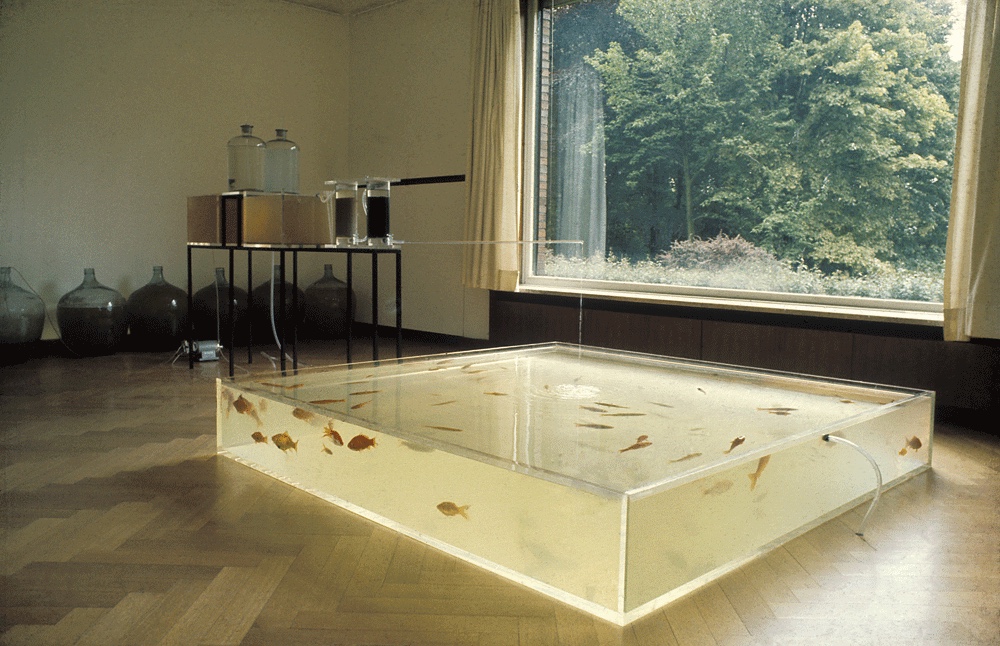
Hans Haacke’s work Rhine Water Purification Plant(1972)consists of a filtration system for Rhine water to be pumped into the shown acrylic aquarium of goldfish in Fig 2, the extra water was then lead out through a hose into a garden which was visible from the gallery [1]. Haacke is commenting on relationships between or divide of ecology and economy. I am interested in the self-doing aspects of the work, making a filtration system which gets rid of the pollutants from the water collected making it liveable shown by the goldfish. I am also interested in how the aspects of science and water quality could play into an art practice exploring ways which ideas of scientific methods could be re worked and reimagined with in an art practice. This work is almost a comment on our pollution but also our possibilities to purify without being so idealistic about our relationship with the natural world.

Emil McAvoy’s work BOTANNOTATIONS (2019) looks at plant identification plates found at gardens, these plates help to identify plants. I find McAvoy’s work to be of interest with its relation to a scientific set of properties, often an object which is seen and helpful to re look at what its meaning my be but also bringing attention to the original identification markers. I hope to reimagine how scientific apparatus can be brought into my practice to help guide work alongside it.
References
1) Gentili,Giulia. Ecology and Economics in the Art of Hans Haacke. Ebook. Scotland: University of Edinburg, n.d. https://llenyd.art.blog/wp-content/uploads/2020/11/f6fd1-gentilihaacke.pdf
Figures
1) Johann Bohm, Untitled (Magnetic Field 2), 1920. Gelatin silver print, 108 mm x 92 mm.. Retrieved from:
https://www.elizabethhoustongallery.com/project/johann-bohm/
2) Hans Haacke, Rhine Water Purification Plant, 1972. Glass and acrylic containers, pump, polluted Rhine water, tubing, filters, chemicals and goldfish. Dimensions variable. Retrieved from: https://www.frieze.com/article/analyze
3) Emil McAvoy, BOTANNOTATIONS, 2019. Installation. Retrieved from: http://www.sculptureinthegardens.nz/emil-mcavoy/
 Llenyd Price