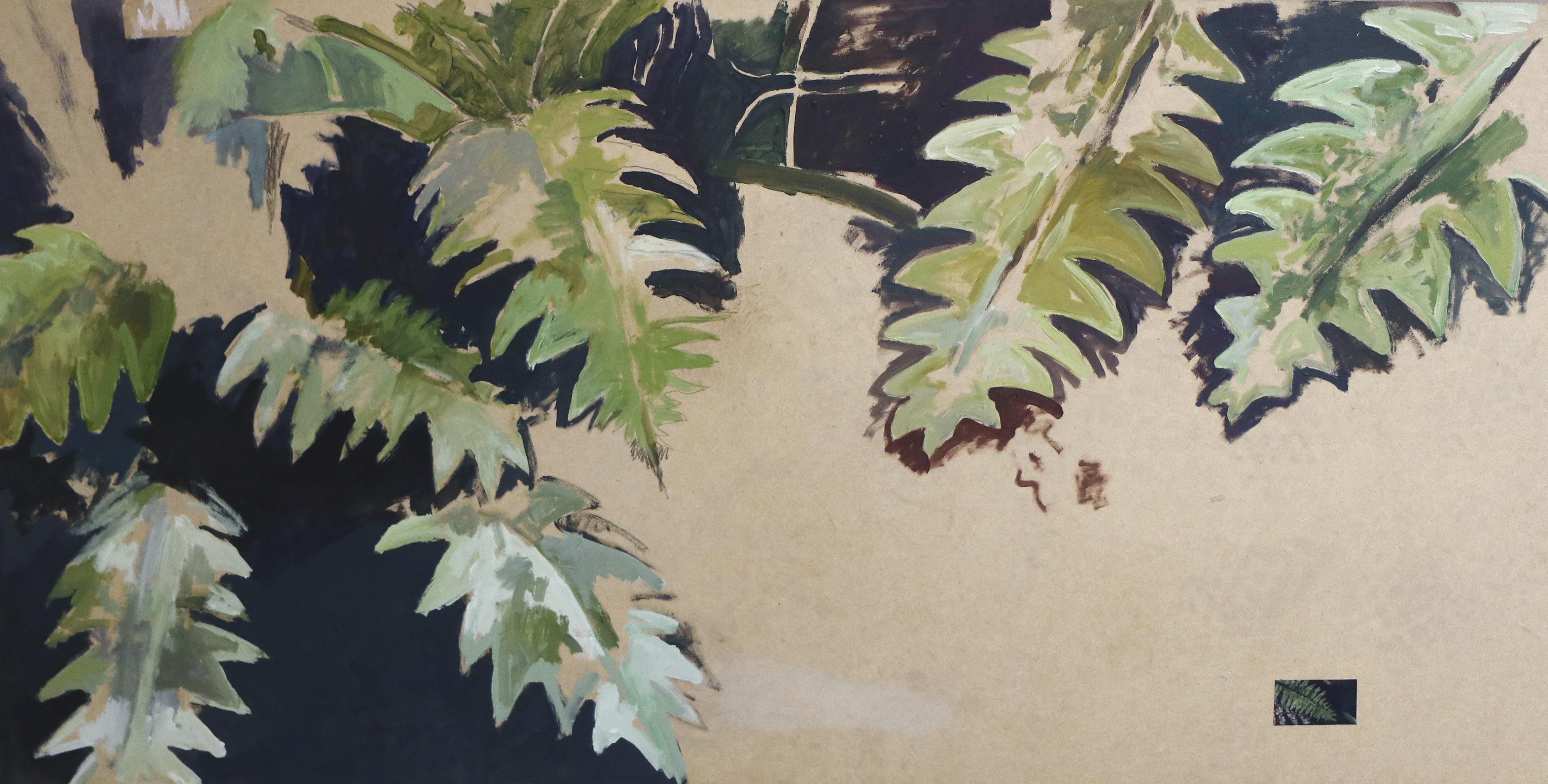
Llenyd Price, ‘Ferns above reserve’, mixed media on found wood, 2019.
Q & A
1) what do you do? What sort of things do you make? Or select?
Broken Landscape Paintings are made on found wooden discarded boards which I have gathered around building or renovation cites. These paintings are based on untouched areas founds around the Waikato, which ended up looking closer at conflicts of land ownership and steward ship with in Kirikiriroa (Hamilton).
These works often represent colonial paintings done by the botanists and artists brought on Cooks ship, artists who would paint the landscapes of which were presented when landing on Aotearoa’s shores. The braking up of these techniques is done, not to bring glory to colonization, but to understand the past events which happened to occur on the fragile ecosystems with-in Aotearoa.
Exploring and understanding how land is being looked after today, a shift towards exploring structures began to emerge, looking at post boards holding information scattered along walking tracks through natural spaces became something of interest for me, boards which would remove from just referencing the past but giving the viewer a possible opportunity to look into present day ways of land maintenance. These connections to the present are, to me, necessary for audience members to bring their own understanding to the issues, to also help them know that it is an ongoing issue which isn’t just reminiscent of the past.
2) What is it you’ve been trying to do to make the work relevant in relation to ideas, cultural circumstances or contemporary issues?
Conflicts and tensions within Aotearoa’s land continue, markers of colonialism still impact indigenous people today, housing development add unwanted pressures to ecosystems, pine farms and animal agricultures demands from Aotearoa getting worse and worse pushing back on fragile ecosystems which have been evolving over millions of years.
At the end of 2019, I found myself interested in the issues of housing development and its impacts on land, which lead to connecting the two areas of issues back then and issues today. I explored ideas came to the fact that housing structures are very similar to the parlor hang, a hanging style which was popularized by colonial galleries.
Understanding these past issues on today enlightened me towards ongoing tensions within natural ecosystems, leading me to now, looking at how land is maintained now in comparison to before, exploring these habitats as sections of reserve in conversation to conflicts.
3) How do you make decisions during the course of your work? How do you select the materials, techniques, themes that you do?
Materials stem from the found material, focusing on discarded wood which referenced the natural, these wood boards were made of reclaimed and processed wood, MDF a board manufactured of old wood and toxic glues, a slight connection from the surfaces of these products could connect a viewer back to these natural environments, understanding that the fragmentations depicting these almost familiar spaces almost translate back to an untouched spaced which has been distorted and shifted through-out a variety of brush strokes which in turn highlight the idea of time, the past histories of a space. Understanding these past times makes me think of the impacts of colonialism, their ideologies of what the land was used for and, to colonisers, going to look like. These ideas of perfecting landscape made me realize the relevance of New Romanticism and the ways artists such as Peter Doig re-imagined the landscapes in which he painted to fit his own story.
I wanted to also explore and understand the issues which had happened and be aware of what had happened within the landscapes, and understand the issues of colonialism which still occur today around land ownership and environmental impacts.
4) Why have you created the work you exhibited at seminar and what is its history?
Issues surrounding land have become an idea which I have explored within my practice, growing up around these spaces and understanding their ongoing issues of ownership and use became more of an interest for myself over the years.
What was shown was a re-organized section from my graduation show Reserve, which looked at the connections between colonialism and housing infrastructure today, an ongoing issue and tensions which we too often see getting pushed aside in order for company’s personal profitable gain.
This previous work touched on the ideas and similarities between modern development which show similarities to past problems of colonialism. Understanding how these may have connections I could start to visually connect these ideas. I started off by exploring ways in which settlers would sell, glorify and advertise the land through paintings. Paintings of landscape depicting what would have been there, looking further into this idea I began to look at what they would do after, how colonisers would showcase the land back home, often showing these paintings in a salon hang, this hanging method inspired my thinking of today and how the gridding and collaging of paintings could be seen to reference building structures of modern housing which are made of wooden frames, I then created a wooden frame which would house the paintings as if they were framed merging the two ideas together.
I also looked at how we understand and navigate the land today which included maps on wooden boards in conjunction to these landscapes, removing the map and adding signifiers such as a specific tree, to communicate the idea of how one may have travelled through these land masses in the past.
As an outsider to Aotearoa my understanding of land began by learning about how these biodiverse areas work as a whole, learning from my botanist father about which plants species are native. I start to understand the land as made up of multiple forms of ecosystems combined together to create an overlapping biological marvel. I had decided that the ways land is being looked after currently has become more of an interest for me within landscape in relationship to the indigenous relationships with land
5) What are you trying to say in the work? What are you valuing in the work?
A story or narrative of what land is left, story moving off from just the figurative painting to what the boards do on their own, the discarded and fragmented in relation to conflicts and pressures of housing development on the land.
Gestural brush marks which sit next to the more timid paint marks representing time being tested in relationship to looking and being in these spaces is, to me, something which I consider to be valuable to these works as they play on the idea of time being played with. Having brush strokes which are or similar start to reinvigorate colonial paintings in forms of being a ‘final’ depiction of a place captured within time.
6) How is the way you are saying it, with the materials, techniques and themes, the best for the idea you want to present?
Working on found pieces of board, much of which is reconstituted wood such as MDF, each work a space in which to bring together these pieces of information,this wood references nature but also deconstruction broking up and processing forming a relationship towards the painting techniques on top of them. Broken land scape painting reflect an emotion or experience of an area within the Waikato region, each painting is based on time spent in one specific location at a time, capturing how I feel in that moment, with the aid of drawings and photographs with added abstracted moments from memory of these spaces. Not held down in one format of painting style or placement, the echo of the experience comes through showing my focus within an area and duration spent, some are quicker forms of painting compared to others, small squares which referenced the paintings done on post cards to advertise land showed a more precise detailed style of painting which intensified the idea of looking into a specific area, alongside this would be more abstracted figurative gestural brush marks which I took from sketches taken during and after walks, originally focusing on my understanding of timeless-ness of a space and remembering decaying sites which still remain undeveloped by building.
By understanding the history of painting I hope to make this work accessible to an audience, by creating fragmented techniques taken from the history of landscape painting in relationship to the processed wooden boards which give a slight reference to the modern structures of housing and building.
Painting on these boards I hope to create a connection for the audience to understand the meaning and importance for these spaces. Breaking a history of painting techniques up over boards I create a direct connection from the modern wood, relating to the logging forests in relationship to the natural forests of Aotearoa, depicting remaining native passages understanding the history of Aotearoa in form of colonization and those artists of whom came over to visit this ‘new land’.
7) How does your current work relate to your previous work?
An exploration of foliage, plant species and found wood boards continue playing a big role in my current practice. Aspects such as navigation of the land both previously and currently have helped understand materials in means of referencing past histories of these landscapes and the destruction which occurred within them. I have previously referenced information board structures within my work, creating a bodily figure which held depictions of the land on them a possible connection to the past use of passages and land as a form of navigation of place such as a specific gathering of tree cluster or rock formation.
A further investigation into the relationships between housing development and land ownership, understanding how the materials which are used can help communicate these ideas through a depiction of natural ecosystems which is true to the history of the land and follows a continuing understanding towards the history of landscape painting. Through this understanding I wish to re-ignite ideas surrounding the experiences within natural spaces to enrich the experiences I have had within native spaces, in order to get others interested in looking after what little native spaces we (in cities) have left to explore.
Only by understanding Aotearoas history can we make connections to what has happened in relationship to the ongoing demands and pressures which come from using up native forests; Housing, farming and invasive pine logging distort and shift the land which was once untouched.
8) What influences your work?
Ecological spaces pressured by the Anthropocene, developing landscapes cleared for humans own greed and selfish wants push not only the known animal species to extinction but also what was once a plethora of endemic and native flora and fauna struggling on the edge of saving. Now opportunities to look past greed arise, help towards preservation of land and these species are becoming a commonality, through getting excited and entranced from the intrinsic beauty inherent in these spaces will we want to learn and enjoy them in their entirety.
Whilst discussing these pressures it is difficult to look past impacts over the land and ownership of land, who should own it, look after it and what the issues are surrounding these spaces. I am starting to attempt referencing housing development to engage audiences to these spaces but also depict the ecosystems dispersed to represent the breaking up or distortion of natural environments. My own selfish curiosities of these tensions help develop my decision making as I am drawn towards how these ecosystems function without human presence but also fascinated by how they can function on the edge of modern society.
9) What are your sources or inspirations for images or forms used?
Paintings made from voyages around New Zealand shows an understanding of the land,the relationship that the looser painting style has with the tighter more realistic painting techniques show direct references to these colonial techniques which mimic time spent at a place in contrast to detailing showing a longer amount of time spent engaged in singular areas, most arranged from photos taken within these specific sites. I bring out details which could be missed if only the memory were to be used.Photos and sketches done on walks with in these areas help me remember where I have been, documenting these spaces of which I have explored and been in, these photos re-ignite any forgotten details, using the camera as a tool to enhance memories playing within areas such as the square boxes of details.
Processes such as sketching reference the colonial naturalist and botanist artists made during their visits to Aotearoa who formed the beginnings of western depictions of Aotearoa. My own sketches made during and after walks helped to get a gestural feeling of these natural spaces, focusing on movement and shapes made from the plants, understanding these areas in a form of living opposed to seeing them in still photographs.
Forms of the man-made impacts onto natural surroundings exploring indicators of land use today are brought in to my practice as I start to delve into forms of navigation today through signs and maps which are plotted alongside walks, these signs have a figurative like form almost as standing within these areas, by looking at these forms I start to combine how these could be brought into a studio or gallery setting, exploring contemporary ideas and forms of exploring a sense of direction and exploration in comparison to just the references to to historical.
10) How does this work fit into a larger body of work or overarching project or ideas (if it does)?
A hope to expand into multiple directions, land protection, ongoing land conflicts constantly felt throughout the country, small pockets of untouched natural environments which are left on the edge of developing cities and how all elements come together, exploration also into contemplating a history of colonizer painting in contrast to contemporary landscape painting within New Zealand Aotearoa.
The possibilities on expanding my practice is available, could what I presented be considered just a section of a final body of work, or could it be seen as a section of a single place where an option of extra exploration is possible.
11) How did your ideas change (if they did) to this point? Or, how are your ideas changing) if they are)?
My ideas originated from recreating experiences of being within untouched ecosystems within Aotearoa, understanding being within them and being surrounded by native flora and fauna. This idea shifted into exploring the surroundings in relationship to the past histories of ownership and stewardship of land and how these stresses over the land are continuing into today’s society.
In order to understand possible solutions, I began focusing on how preservation of native plant species could start to reshape our relationship around land ownership and control, by understanding what grows naturally we could start to understand their importance.
In hopes to re-engage with previous ideas I recall my own experiences within these spaces, in understanding the problems I begin to make connections towards the idea that keeping these spaces, from a non-bias perspective, is necessary.
I wish to understand how materials can play a part in conveying these thought processes, how painting can help to show these lands as a place to maintain and not be a place of destruction nor be over looked.
In hopes to further push my current practice I am hoping to emphasize these ideas within a contemporary art practice which both understands the history of Aotearoa and how landscape painting sits within a contemporary art scene.
12) Has anyone done this kind of work in the past?
I have referenced many colonial artists, botanists have played a part, plant biology and plant study, such as Artists such as John Webber who companioned Captain James Cook on his passage to New Zealand in the 1770’s. The studies which John Webber made of Aotearoa helped to lure the British back to New Zealand, studies of Aotearoa have helped me with my own work [1].
Toss Woolenstin’s gestural landscape paintings have also influenced my practice, investigating how certain landscapes within Aotearoa depicted could be constructed from a limited colour pallet alongside thick paint, Woolenstin doesn’t focus in on details but helps present the land as living through his brush marks. Another artist that deals with the landscape in a gestural and abstracted sense is Ivon Hitchens, who depicts the British woodlands through quick brush marks, again not giving the viewer too much detail but giving off the sense of movement within these landscapes
Artists within the Cubist movement depicting objects encapsulated by its many angles of observation rather than looking at subjects from a limited access of view-points, front on or other singular perspectives.
Louise Henderson’s work also explores New Zealand’s flora through layering, playing around with what appears in front or behind, continuing cubist ideas of multiple perspectives forming a final ‘experience’ of the subject.
- Te Papa Museum. “Biography of John Webber.” Accessed September 16, 2019, https://collections.tepapa.govt.nz/topic/573
13) Does anyone else do it now? Who are the artists that occupy this terrain?
I have continued to look at New Romanticism to understand how one shows off the land scape, although I don’t mimic these artists, I enjoy the idea of creating a work that brings inherent beauty into the works from the real world, even if it is distorted through the mind to invite others as well. cover up and erasing sections of the work, calls back to many ideas such as how the colonizer painters would have gone over their paintings many times until they had captured the land to their liking, creating something which was inviting for other settlers, but is also a reference to the ways in which colonisers erased the land to set up camps, cutting down forests and these select sections around the Waikato are testimony to reclaiming the land and bringing them back to what they may have once been like.
With a distortion and layering of multiple subject matters encapsulated within nature I also begin to explore the landscape paintings made by Barbara Tuck, these distortions of landscapes show a variety of techniques and subjects which relate and feed off of one another to create a ‘finished’ painting.
David Hockney’s work Pearblossom Hwy., 11 – 18th April 1986, #2
shows a mixture of perspectives which have been brought together to recreate a final image [1], the ideas surrounding this collage is something which I have played with, picking and choosing in many ways what is to be shown, highlighting the specific areas of which I wish the viewer to see. By enhancing and playing with time I hope to capture moments which display a variety of time spent within these areas to represent the timelessness of the spaces of which I am depicting.
- Sykes, Christopher Simon. “Hockney: The Biography, volume 2: 1975-2012.” getty.edu. http://www.getty.edu/art/collection/objects/105374/david-hockney-pearblossom-hwy-11-18th-april-1986-2-british-april-11-18-1986/(accessed March 16 2020)
14) Who are the writers on these subjects? What specifically have they said, which motivates your own thinking for your work potentially?
Writers in this domain deal with how art and materiality can fit within the contemporary changing world, aware of the ongoing issues of consumption and the continuing effects of the Anthropocene.
Revaluing discarded materials is an important part of my practice as I believe there is no need to create more waste material, giving rise to these found materials illustrates to the audience the importance of recycling objects, not overlooking waste as being just rubbish. Eco-Aesthetics is a book whichbrings the attention closer to a material approach to Eco-art, being aware of the initial attraction in the mundane or discarded object, re-evaluating the worth of waste material, giving it a new life beyond the wastelands [1].
How we interact with objects in the world is a topic brought up in Carnal Knowledge, describing science as an observation, aesthetic art as a direct connection from the sensing body and its phenomenal encounters with the material world. Science and art create different ways of encountering the material world, where one is the search for an evidence based answer, and the other an intuitive and sensorial engagement that fosters the creative formations of meaning as it unfolds between the artist, the artwork and the viewer [2].
If there is a disruption in the conscious understanding of an object from a lack of language and or symbols, there is often a necessity to create new forms of language to help aid our interactions with what is often the unknown. These new languages created are often subjective, and created from our past experiences within the material world.
- Miles, Malcom. Eco-Aesthetics: art, literature and architecture in a period of climate change. London, UK: Bloomsbury Publishing Plc, 2014: 167-194.
- Barrett, Estelle, and Bolt, Barbara. Carnal Knowledge: Towards a ‘New Materialism’ through the arts.New York: I.B.Tauris & Co, 2013: 63-72.
15) Is your field an established one or did you have to invent it? What histories are you contributing to?
Within the process of broken landscape painting, multiple artists appear to touch on similar ideas surrounding the landscape and our relationship to the history of landscape painting. Understanding colonial art but avoiding the glorification of colonisation, looking at the land as a place to cherish rather than a space to own. Understanding Barbara tucks use of landscape layering and also David Hockney’s use of multiple vantage points to come into play to create a ‘finished’ image, Hockney uses multiple angles of the same subject, referencing many cubist ideologies.
Cubist ideas surrounding perspectives are played with, being another way of viewing the world playing a role within my practice shifting between forms of how viewing my own subject matter changes. Fragmentations of angles and time are framed playing with one another, bringing in my own experiences within these spaces. These ideas stem from Cubist artists such as Pablo Picasso of which explore the object from multiple angles, experiencing the object as if it was viewed at all directions at once. Picasso quoted “A picture used to be a sum of additions. In my case a picture is a sum of destructions.”[1]
Hockney plays with cubist ideas in his work The Desk,a collage of a desk taken from all possible angles available to immediately be viewed [2].
These ideas helps develop my own practice by creating engaging new ways of interacting with landscape painting.
- Ettiger, Tom. 1989. “Picasso: The Pictorial Structure of Cubism and the Body-Image Construct”. PEP-web.org. https://www.pep-web.org/document.php?id=pct.012.0147a (accessed March 12, 2020)
- Druckenmiller, Fiona. “The Desk, David Hockney, 1984”. fd-gallery.com. https://fd-gallery.com/wall-desk-david-hockney-1984/(accessed March 10, 2020)
 Llenyd Price